Showing posts with label Soccer 101. Show all posts

Thursday, June 10, 2010

Soccer 101: What is the World Cup and Why Should I Care?

We are so tantalizingly close to the World Cup, the excitement is palpable. Tonight, millions of soccer fans will go to bed and slip into fantastic dreams about their country's team making a heroic run in the cup. Tomorrow, the wait will be over as the first ball is kicked and the first matches played for the 2010 World Cup in South Africa. But how did the World Cup become such a huge deal?


THE FIFA WORLD CUP


The World Cup as Americans know it is actually the final stage of a two and a half year long competition involving 205 countries and more than 900 matches. The World Cup Final is contested by the remaining 32 teams who have qualified to compete for the trophy every four years.

Brief History
The brainchild of then FIFA president Jules Rimet, the first World Cup Final was held in 1930 with Uruguay as the host. While all FIFA member countries were invited to take part in the tournament, due to the travel expenses, very few teams outside the Americas made the trip. Uruguay went on to win the tournament in front of a crowd of 93,000 people. An international phenomenon was born.

The World Cup has been contested in some form every four years for the past eight decades (with the exception of 1942 and 1946, due to a tiny global snafu known as World War II). Only seven countries have won the tournament, and only five of those countries have done it more than once. For the record: Brazil has won the World Cup 5 times (1958, 1962, 1970, 1994, 2002), Italy 4 times (1934, 1938, 1982, 2006), Germany 3 times (1954, 1974, 1990), Argentina and Uruguay have both won 2 times (1978, 1986 and 1930, 1950, respectively), and both France and England have won the tournament 1 time (1998 and 1966, respectively, and both while hosting).

While the exact details of qualification change every four years, the current system of all eligible teams competing for 32 spots in a group round robin followed by a single elimination tournament was only introduced in 1998.

Qualification
The international soccer community is divided into six geographic confederations, each of which is giving a certain number of slots at the finals:
  • Africa (6 places, including 2010 host)
  • Asia (4 or 5 places)*
  • Europe (13 places)
  • North America, Central America and the Caribbean (3 or 4 places)*
  • Oceania (0 or 1 places)*
  • South America (4 or 5 places)*
The teams in each region compete in a multi-round, seeded round-robin competition for spots at the World Cup finals. Each region is designated a certain number of spots in the world cup according to the strength of its countries.

* For many of the regions, the total number of spots allotted depends on inter-continental playoffs between countries in the final rounds of qualification, hence why the weaker countries of the Oceania confederation - teams such as Fiji, the Solomon Island and New Zealand - are not guaranteed a spot in the finals. To qualify for the 2010 tournament, New Zealand (the winner of Oceania qualification) had to defeat the fifth place team from Asia's qualification. Likewise, as the fifth place finisher in South America, Uruguay had to beat North America's fourth place finisher for a spot in the finals. For complete details on the qualification process, see here.

The first rounds of qualification for the 2010 FIFA World Cup Final in South Africa began in the October 2007 and finished two years later in November 2009.

The Finals
Once the final 32 teams have qualified, they are divided into 8 groups of 4 teams each. In the opening stages of the tournament (known as the group stage), the teams play three matches, one against each of the other teams in the group. The teams receive 3 points for a win, 1 point for a draw and 0 points for a loss. The two teams with the most points advance to the knock out rounds of the tournament.

The final four stages of the tournament are single elimination knock-out until a champion is crowned. A game to determine third and fourth place is also played. The entire tournament takes a month.

Why should I care?
Quite simply because there is nothing like the World Cup. Nothing. And in 90 minutes, anything can happen. Anything. There are the favorites to win, to be sure, but every four years a few teams of which nothing is expected shock the world and strike down the great powers on their way to unthinkable glory (think the USA and South Korea in 2002). It's as compelling as sports gets and it's the most universal sport humanity has. There. Is. Nothing. Like. It.

Tomorrow on Soccer 101: The freaking World Cup. Go watch it already! ... But if you want to swing by here, we'll have Saturday's TV listings (tomorrow's World Cup TV listings will be posted later today).

Wednesday, June 9, 2010

Soccer 101: The Rabid Fans

So we've dealt with the rules (even that really confusing offside one). We've dealt with the faking. We've dealt with the player's positions and team formations. We've even dealt with the referees and their roles in a game. There's only one large enigma left to explain to the soccer newcomer: The millions of people around the world who actually enjoy watching, following, living and breathing this game.


SOCCER FANS


Ok, you may think you've met something like a soccer fan. But you haven't. You've seen teamsters strip down to their underwear for Green Bay football. You've seen half naked white trash follow their favorite NASCAR drivers around the country in a trailer. You've seen a guy drop his toddler to catch a fly ball. But you still haven't seen anything like a soccer fan.

Soccer is not just a passion for these people. It's not even an obsession. It's a way of life. Period.

Not only have some soccer clubs been around for 150 years, they are often supported by generations of the same family, from the same neighborhood.

Consider this: America supports three major professional sports with about 30 teams each. In England alone, the entire soccer pyramid contains 7,000 teams, every one of which could theoretically rise and fall to either the very top or the very bottom of the league system. And each year over 700 professional, semi-professional and amateur teams compete each year for a single trophy, the F.A. Cup.

Soccer fans love their teams so much, they sing about it and the songs aren't even 25% vulgar ... most of the time. Although, it can be kind of disturbing watching thousands of German fans chant anything in unison.

So when the World Cup comes around every four years, the fans in these countries skip work en masse. Many countries (including Germany during 2006 and South Africa in 2010) grant official public holidays during the tournament. All activity in countries such as Brazil, for example, completely stops while their national team is playing.

American's love their sports, there's no doubt about it. But when it comes to soccer - a sport played by nearly everyone else everywhere else in the world - we're talking about the closest thing to a universal language humanity has ever known. That is a passion on a scale even Yankees fans, Dallas Cowboy fans, Los Angeles Lakers fans cannot match.

It's a beautiful game to play. It's a beautiful game to watch. And it's a damned beautiful game to be a part of.

Tomorrow on Soccer 101: What is the World Cup and Why Should I Care?

Tuesday, June 8, 2010

Soccer 101: Why is that Guy Rolling on the Ground?

Without out a doubt, the most common criticism Jim Bobs everywhere have of soccer is the players just seem so wimpy. To the novice, soccer appears to have a slow speed and little physical contact. So when a player hits the deck, writhing in agony as if he'll need his leg amputated from a seemingly innocuous challenge, people used to watching men the size of household appliances crashing into each other in full body armor are less than impressed. Add to this the fact that many of these displays are in fact fake and the people in question are left with a less than endearing impression.


SOCCER'S (BAD) ACTING


The situation: A fast paced player (perhaps a winger?) is weaving in and out of defenders down the field. His feet are like lightening and his vision seems ingenious. Then, just as he's reaching the top of the penalty box, the ball gets away from him and he crumples against a solid challenge from a defender. After three flamboyant rolls, he is left clutching his knee or his ankle or his back or his face, wincing in agony as if he is about to pass a paperweight-sized kidney stone. Is he bleeding? Does he need medical attention? Is he going to die?! Clearly, a foul has been committed.

But the referee is unimpressed and dismisses the situation with a frown and a wave or even a wry smile and a wagging finger. The player may stay crumpled on the ground for a bit, but eventually he gets up and continues playing, back to fine health. And no one says another word about it.

So why did he go out of his way to fake an injury? The answer is simple, but the reasoning is a little harder to understand. The player is trying to draw a foul and give his team some sort of advantage.

Players draw fouls because they want to influence the referee's decisions and they know they can get away with it. Soccer can be an incredibly dangerous game with players experiencing compound fractures and concussions. On top of this, the real-time, fast-paced nature of soccer means that referees are often yards behind players (who can be as much as half their age) when calls need to be made. So when a player is fouled (or not), the referee may not always be in the best position to make the correct call, so he must make an educated guess.

The catch? Intentionally faking a foul (or simulating) is against the rules and punishable by a yellow card. But in a game where infractions can take place in the blink of the eye and yards away from any official, how are the referees to know which are real and which are faked? As a result, players are only called for simulation when it is particularly obvious, often in the box. However, more often than not, players get away with it. A problem? Yes. But the best referees can minimize its impact.

Tomorrow on Soccer 101: The Fans

Monday, June 7, 2010

Soccer 101: That Damned Offside Rule

Bum, dum, DDDUUUUMMMMMMM! The offside rule in soccer is - after Cristiano Ronaldo - the hardest thing to explain to new fans. It involves what every novice enjoys: A long, fumbly explanation with a lot of qualifiers. Just when a new soccer player thinks they understand it, the person explaining it adds "But only if ..." and inevitably has to resort to visual aids. But have no fear, I shall be clear and concise with my explanation.


THE OFFSIDE RULE

Manchester United forward Wayne Rooney
attacking while defenders protest for offside


In its simplest form, the offside rule exists to stop an attacking team from gaining an unfair advantage. With only 22 players on such a large field, it would make for an uninteresting game if a team could just plant one player without the ball two yards from the goal and play long balls up the field to him. In other words, the offside rule attempts to ensure the attacking team cannot have players without the ball closer to the goal than the opposing team's defenders.

Play will be stopped for offside if the situation meets two criteria:
  1. A player without the ball is in an offside position when the ball is intentionally touched or played by another member on his team
  2. The player is deemed to be "active" by the referee (often on the advice of his assistant)
Note that it is not strictly illegal for a player to be in an offside position, only if he is both in an offside position and active in the run of play (often determined by touching the ball).

Offside position
A player is in an offside position, if he is closer to his opponent's goal than BOTH the ball and the second to last defender (the often goalkeeper being the final defender).

A player is NOT in an offside position if:
  • He is in his own half of the field of play, or
  • He is level with the second to last defenders, or
  • He is level with the last two defenders
Being "active"
A player may be considered "active" by the referees if he is:
  • Interfering with play, or
  • Interfering with an opponent, or
  • Gaining an advantage by being in that position
Please note that a player may be level with the second to last defender when the ball is played by a teammate and then receive the ball in an offside position, but will still have not broken the offside rule.

Exceptions

To complicate matters further, a player cannot be offside if he receives a ball directly from a goal kick, throw in, or corner kick.

How it normally looks during the game
Many teams operate an offside trap at least once during a match. When operating the trap, the back four defenders keep a straight line across the field and step up right before the attacking team attempts to play a ball into space behind. This action often renders the recipients of the through ball in an offside position, and if the timing is correct, play will be stopped and the attack quelled. On the other hand, attacking players work hard to time their runs off the ball in order to receive a ball behind the defense without committing an offense. Far too often, it is a matter of inches, and the officials have only seconds to decide whether or not a player has violated the offside rule.

Got all that?

No?

Well, crap. That wasn't as concise as I would have liked it to be. Oh well. If you're still confused, watch this video. It has fun music, pretty pictures, and a Scottish narrator.

Tomorrow on Soccer 101: Why is that Guy Rolling on the Ground?

Sunday, June 6, 2010

Soccer 101: The Officials


Just like any other sport, the team of officials in a soccer match can have a drastic impact on its tone and even its outcome. However, unlike many games, the soccer referees have a kind of organic, real-time control over the game, often with a certain freedom of interpretation and discretion. Most importantly, however, there is no instant replay for the refs, no matter how many times ESPN wants to show you a slow motion clip.


SOCCER OFFICIALS

The professional soccer matches you see on television will have a team of four referees on and around the field officiating.

The Referee (The Guy with the Whistle)


The referee is the only official on the field with the players. His is the final word during the game. And while he may consult with his three assistants, none of them may use video evidence of any kind to influence their decision. Ironically, this includes replays on a stadium's television.

The referee calls fouls and infractions, starts and stops play, keeps the official time for the game, and determines how much stoppage time is to be added at the end of each half. He can grant free kicks or penalties and he can caution a player with a yellow card or send a player off for the remainder of the game with a red card. When a player receives a red card, his team is forced to play the rest of the match with 10 men (or 9 men if two players receive a red card, 8 if three players do, etc.).

A yellow card is given for:
  • Unsporting behavior (including simulating or faking a foul)
  • Dissent by word or action
  • Persistently infringing the laws of the game
  • Delaying the restart of play
  • Failing to respect the required distance of a corner kick or free kick
  • Entering or re-entering the field of play without the referee’s permission
  • Deliberately leaving the field of play without the referee’s permission
A red card is given for:
  • Serious foul play (eg., a violent foul)
  • Violent conduct
  • Spitting at anyone
  • A deliberate handling offense to deny an obvious goal-scoring opportunity by any player other than a goal keeper in his own penalty area
  • Committing an offense that denies an opponent an obvious goal-scoring opportunity (eg., "professional fouls")
  • Using offensive, insulting or abusive language or gestures
  • Receiving a second caution (yellow card) in one game
However, a referee's primary role often puts him in control of the tempo, flow and dynamic of the game. If the referee is a strict disciplinarian, he may stop and start play for fouls constantly, thus disrupting any free-flowing play that may have otherwise developed. On the other hand, if the referee is more willing to tolerate physical challenges, the game may take a more open but outwardly physical nature. Typically, you can learn the most about a referee's style by the type of foul for which he gives his first yellow card of the match.

One last note to make is that a referee does not have to immediately stop play when a foul has occurred. He can opt to allow play to continue if the team committing the foul would otherwise receive some sort of advantage (often defensive) from play being stopped. This is known as the Advantage Rule or Play On.


Assistant Referees (The Guys with the Flags)


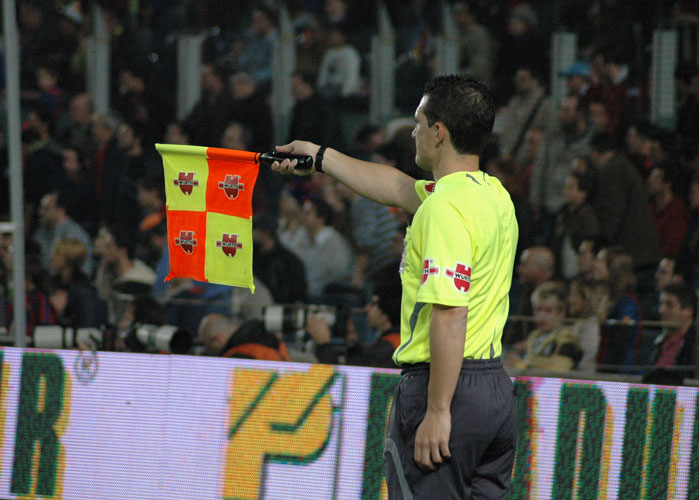
The referee is accompanied by two assistant referees who occupy the opposite touchlines of opposite halves of the field. All of the assistant's decisions are advisory to the referee. He may use his flag to signify if a ball has gone out of bounds, if a foul has been committed, or if a player is in deemed to be off sides, but it is the referee who decides whether or not to stop play for any of those situations. For the most part, a referee will defer to an assistant referee in matters of off sides and balls going out of play.


Fourth Official (The Guy With the Lite Brite Board)


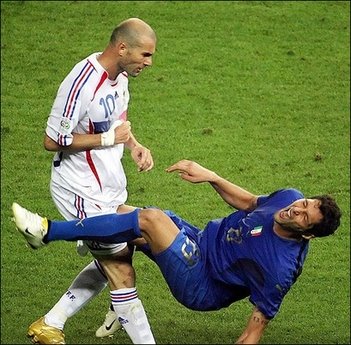
The fourth official acts primarily as an administrative assistant to the on-field referee. He ensures that substitutions (each team is allowed only three in a match) are carried out efficiently and communicates the amount of stoppage time on a lighted board. The fourth official may also act as an additional set of eyes for off the ball infringements or infringements that take place during confusing times of the match. For example, while the referee did not see Zinedine Zidane's infamous head butt during the 2006 World Cup final, the fourth official did and advised the referee in his decision to send off Zidane with a red card.

Tomorrow on Soccer 101: The Dreaded Off-Sides Discussion

Saturday, June 5, 2010

Soccer 101: The Players and Their Positions

One of the hardest things about understanding a new sport is learning the positions the players occupy on the field. You can watch cricket all day, for example, and still have no idea what's going on if you can't assign the proper commentary to the bowler, batsmen, wicket keeper, silly mid-off, fly slip, cover point and so on and so forth. The same applies for soccer. If you don't know what positions the players occupy, then it will be hard to understand the flow of the game.


PLAYER POSITIONS

As mentioned in the Rules and Overviews post, each side in a soccer match fields 11 players, with one goal keeper and ten field players. Below are the most common positions found in modern soccer teams.

Goal Keeper
The goal keeper is charged with defending the team's goal. He is the only member of the team allowed to touch the ball with his hands. However, he is only allowed to touch the ball with his hands inside the penalty box. The position is a highly specialized one, making it rare for modern keepers to ever play another position on the field.

Center Backs
The center backs are a team's defensive foundation. Their primary roles are to stop attacks by the opposing team into their penalty area and to win aerial balls in that part of the field. Most teams employ two center backs who will either defend a given area of the field(zonal defense) or defend a specific player on the opposing team by closely marking that player (man-to-man marking).

Wing Backs / Half Backs / Full Backs
Call them what you want, full backs, wing backs, half backs, these positions occupy the outer edge of the defense. The exact name of the position differs according to the player's tasks and the team's overall strategy. However, in the modern game, the players on the wings of the defense are responsible for stopping the opposing team from distributing the ball into the penalty area and assisting with counter attacks up the field.

Center Midfielders
Center midfielders can have a wide range of roles and responsibilities depending on their strengths and the team's strategy. They will both defend and attack, depending on the flow of the game and which team has the ball. Their primary goal is to take pressure off of their back four defenders (known as the back line) by giving them someone to pass to and then distribute the ball to the wingers or attackers.

Wide Midfielders / Wingers
The flanks of the midfield are often staffed by the fastest and most technically skilled players on the team. These players assist primarily in the attack and are expected to distribute (or cross) the ball into the opponent's penalty area. If these players have dynamic attacking skills and cripplingly precise vision, they can draw a well-formed defense out of position in attempts to shut them down, thus opening opportunities (an space) for the attacking players in front of goal.

Attacking Midfielders

Depending on a team's midfield configuration, they may utilize a player caught in the Hole between the attackers and standard midfield line. These players often act as the attacking pivot for the team, linking up with the strikers to create goal scoring threats. They will often display good decision making, knowing when to feed the front line and when to take a shot on goal.

Forwards / Strikers
There are semantic differences between forwards and strikers, but for your reference, these are the guys responsible for scoring a good portions of their team's goals. A forward may be responsible for keeping possession of the ball with is back to goal while his team gets forward to attack, while a striker is tasked primarily with making well timed runs to beat defenders.


FORMATIONS

The way in which a team takes the field is known as its formation. When formations are discussed, the numbers of players are listed in defense, midfield and attack, with the keeper being omitted as an assumed position. For example, England has traditionally taken the 4-4-2 formation (left), with 4 defenders (two center backs, two full backs), 4 midfielders (two center midfielders, two wingers), and 2 forwards.

The team's formation says a lot about their strategy, tactics and strengths. For example, the 4-4-2 formation allows the two central midfielders to control the flow of play and distribution of the ball with the wingers and full backs moving up and down the wings to support the attack or defense as needed. This formation allows for coordinated defense and quick-breaking counter attacking football, both of which are highly valued in English league soccer. Portugal's formation, on the other hand, employs a 4-4-1-1 which gives the infamous Cristiano Ronaldo room to roam up front as a second striker and terrorize defensive lines.

Other common formations are 4-1-2-1-2 (the diamond formation currently used by Chelsea and utilized vintage Manchester United), 4-3-3 (used by Spain and the Netherlands in the 2006 World Cup), 4-2-3-1 (popular with French sides) and 4-5-1 (a defensive formation used to absorb pressure and grind out results or preserve existing leads).

Tomorrow on Soccer 101: The Officials.

Friday, June 4, 2010

Soccer 101: Everything You Never Wanted to Know About Soccer

This post is for those of you who may enjoy soccer casually but have forgotten the ins and outs of the game ... mainly the rules. In the next seven days leading up to the World Cup, I will be examining and explaining the finer points of the Beautiful Game so you may find yourself respectably prepared for the world's biggest sporting event: the 2010 FIFA World Cup.


RULES AND OVERVIEW

Soccer (or Association Football) is played by two teams of 11 players on a rectangular field. The object of the game is to put the ball in the opponent's goal without the use of your arms.

The field: What are all these lines?

Add VideoThe field (or pitch) is typically between 110-120 yards long and 70-80 yards wide. It is divided in half by a white chalk line. The length of the field is denoted by two touch lines. Two goals are centered on the opposite goal lines, running the width of the field. Each goal is bounded by a six yard and an eighteen yard box (known as the goal and penalty boxes, respectively). The rest of the lines are recognized only during specific situations and typically denote the minimum distance players must stand during a particular event (eg. The arc at the top of each penalty box denotes the closest players not involved in taking a penalty kick may stand while the kick is being taken, the center circle denotes the closest players on the team not partaking in a kick off may stand to the kick off).


The Goal and Scoring: Ok, so how do you win this game?

Each team defends a goal 8 yards wide and 8 feet high. A goal is scored when the ball has completely crossed the imaginary plane created by the goal line, two vertical goal posts and the horizontal cross bar. Each team receives one point for each goal scored.


Time Keeping: The clock is counting UP?! When does this game end?
A soccer match consists of two, 45 minute halves. The clock starts at the beginning of each half with the referee's whistle and does not stop for anything until the end of the half. If, during the course of a half, events such as injuries, substitutions, goal celebrations or outside factors have stopped or delayed play, the referee may add, at his or her discretion, more playing time on to the original 45 minutes. This is known as stoppage time.

Each half begins with a kick-off at the center point of the half-way line.


Out of bounds: The ball crossed those white lines, now what?
A ball is considered out of bounds when the entirety of the ball has crossed the entirety of the imaginary plane created by the touch or goal lines. When a ball goes out of bounds, the team who touched it last gives up possession to the other team. If the ball crosses one of the touch lines (or side lines), a throw in is given. If the ball crosses a goal line (but does not count as a goal) and is touched last by the attacking team, a goal kick is given to the defending team and taken from the edge of the six yard goal box. If the ball crosses the goal line and is touched last by the defending team, a corner kick is given to the attacking team.

Tomorrow on Soccer 101: The players